Classification and Introduction of Heat Exchangers in Refrigeration Systems
Refrigeration units are the core equipment of refrigeration systems, with well-defined classification standards widely adopted across the industry. Classification is primarily based on the heat transfer medium of the condenser (heat rejection side) and evaporator (heat absorption side), supported by a standardized naming formula that is intuitive and well-recognized in the sector.Naming rule: Naming = Condenser cooling method + Evaporator heat transfer medium.This rule directly identifies the unit’s operating mode, heat exchange principle and applicable scenarios, serving as a key reference for equipment selection, procurement and maintenance.
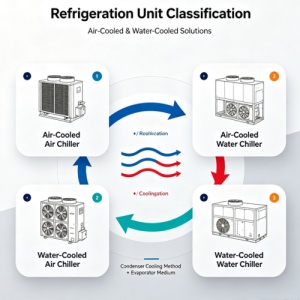
First, let’s clarify the heat exchange principles of the two core components. The condenser works on the heat rejection side, discharging heat generated by the refrigeration cycle; its cooling media are mainly air and water. The evaporator is on the heat absorption side, achieving refrigeration by absorbing heat from the medium, with air and water as its primary heat transfer targets. Combinations of media for these two components correspond to the standard unit names. The industry also uses simplified names. The four mainstream types of refrigeration units and their applicable scenarios all follow this formula without exception.
Based on the naming formula, mainstream refrigeration units fall into four categories, each with designated media and application scenarios:
Air-cooled air chiller, also known as air-cooled unit. The condenser is cooled by air, and the evaporator exchanges heat with air. It is the most common type for residential and commercial use, widely applied to household air conditioners, commercial packaged units and direct-expansion refrigeration systems.
Air-cooled water chiller. The condenser uses air as the cooling medium while the evaporator transfers heat to water. Suitable for small and medium-sized central air conditioning and sites without cooling towers. It features flexible installation and requires no auxiliary water cooling equipment.
Water-cooled air chiller, often shortened to water-cooled unit. The condenser is water-cooled and the evaporator exchanges heat with air. This type is relatively rare, mostly referring to water-cooled packaged units and direct-expansion water cooling systems.
Water-cooled water chiller. Both the condenser and evaporator use water as the heat transfer medium. It delivers top-tier heat exchange efficiency and is widely used for high-power cooling applications such as large-scale central air conditioning, industrial cooling and data center temperature control.
This medium-centered classification and naming system avoids complicated jargon. Users can easily understand the cooling method, refrigeration type and applicable scenarios just from the name, without analyzing internal structures. It facilitates communication within the industry and helps non-professionals quickly distinguish different equipment. As a universal, standardized classification principle in the refrigeration industry, it offers great practical value.